 CC
CC 
Guide · 01 · Permits
The paperwork that comes before the pilings
Most structural dock and lift work on SW Florida water needs a permit. Here is what a review is actually looking at, what makes it move quickly or slowly, and where a skipped one shows up later.
Skipped paperwork sends the bill years later
Nobody buys a canal home because they were excited about permitting. You want the boat in the water and the coffee on the deck. So the temptation is real: the dock is small, the canal is behind the house, who is going to notice a few boards and a couple of pilings.
The answer is whoever comes next. A structure that has no record behind it tends to surface at the worst possible moment: at closing, when a buyer's agent asks for the file. At renewal, when an insurance review wants to know what is attached to the seawall. Or the day you finally want a lift, and the application for the lift raises questions about the dock it would sit on. None of those are good days to discover the problem.
Done the other way, permitting is just a phase of the job with a start and a finish. We scope the build around Lee County and City of Cape Coral dock rules and walk you through the permit steps, so the structure you end up with matches the record behind it.
What a reviewer is actually asking
What kind of structure it is
A walkway, a platform, a lift, a boat house and a pile of replacement boards are not the same project. The structure type is the first fork in the road, and it decides which lane your application travels in before anyone looks at a drawing.
Which water it stands in
Jurisdiction follows the waterway, not your street. A residential canal, a river frontage and open bay water can each carry a different review path, and some waterways add a layer beyond the local one. Two neighbors on different sides of a line can face different answers for the same dock.
How far the structure reaches
Reviews care about how far you extend from the seawall, how close you come to the property lines on either side, and what that leaves for navigation. This is the part owners underestimate, and it is why layout gets settled before anything is ordered.
What is already on record
Existing structures matter. Whether the current dock was ever permitted, what was approved at the time and what has quietly changed since all shape what you are allowed to do next. Buyers of older waterfront homes inherit this file whether they read it or not.
Repair, replace, or new
Scope of work is a real category, not a technicality. Swapping boards on a sound frame is a different conversation from replacing framing or driving new pilings. Where your job falls on that line changes what is required, so we define the scope honestly at the inspection instead of after.
Whether the drawing answers the questions
Vague submissions stall. A review wants to see the layout, the pilings, how the frame goes together and how the whole thing meets the seawall. Complexity does not slow a review down nearly as much as ambiguity does.
How the permit phase actually moves
Free inspection first
The owner walks your dock and seawall, free, and you settle what you are actually building. Almost every permit question downstream traces back to a scope decision made in this conversation.
Scope to the rules
The dock gets designed around your boat, your canal and your seawall, and we scope the build around Lee County and City of Cape Coral dock rules. Outside Lee County, rules differ by city and county, so the same drawing can meet a different path one waterway over.
Walk the permit steps
We walk you through the permit steps: what the application covers, what a reviewer will be looking for, and where things stand as it moves. You are not left guessing what stage your project is in.
Answer the questions
Reviews come back with questions. That is normal, not a red flag. The projects that clear fastest are the ones where the questions get real answers quickly instead of sitting for a week.
Then the barge shows up
Once you are clear to build, the pace changes completely. Pilings go in from the water, the frame and deck follow, and the job ends with the owner on your dock and your boat tied to it.
Real work, real water
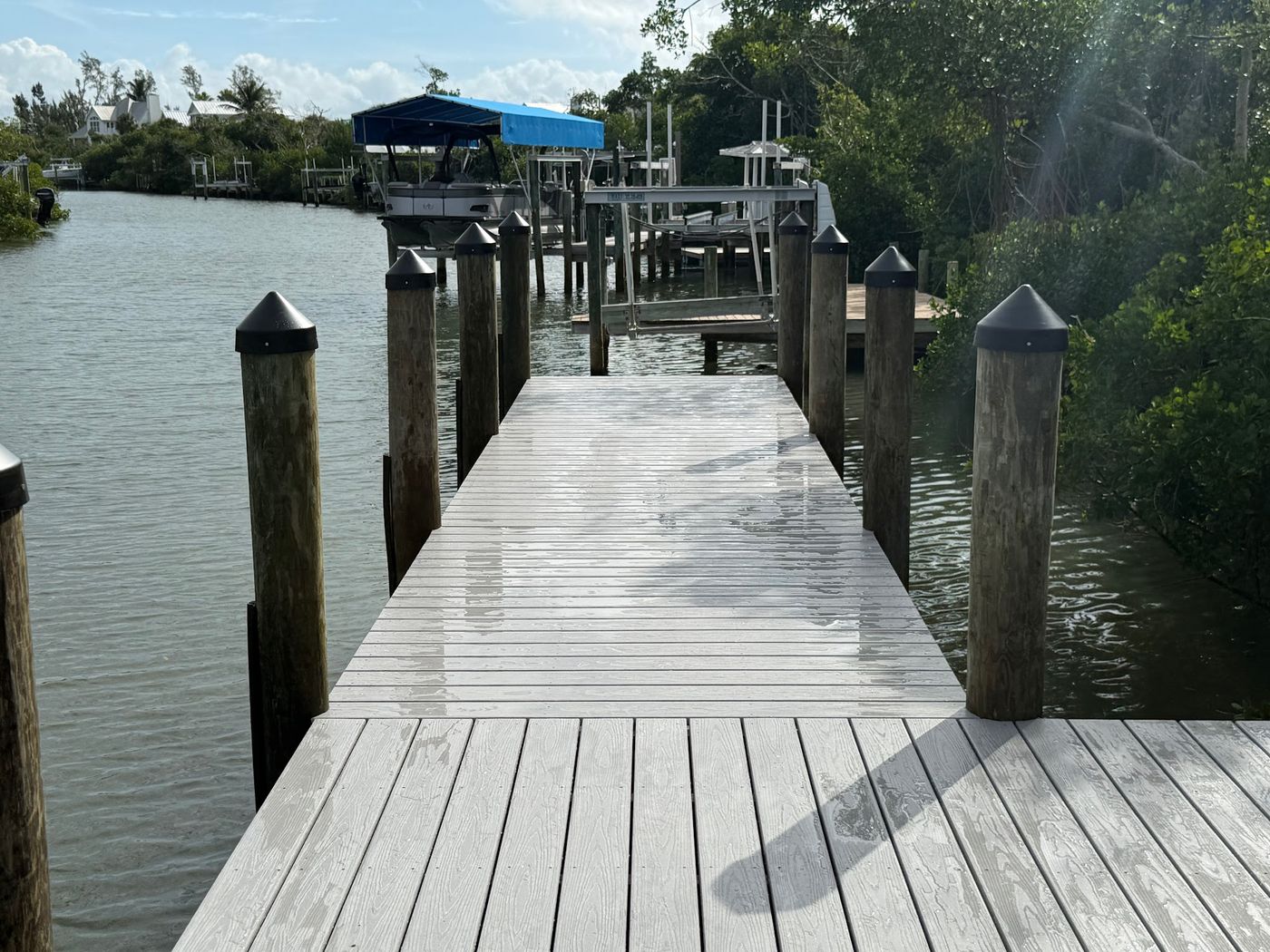
Every photo is our own work on SW Florida water. Click any of them to look closer.
Rated 5.0, 98 reviews
“Hiring Alex and his crew was a great decision! First and foremost they showed up when they said they would and perhaps even more important, finished when they said they would. ... I only wish I'd hired Alex from the start.”Vince Kotlarz · Google
The slow part is almost never the build
Owners tend to picture the barge as the bottleneck. It rarely is. Once the pilings are set, a dock takes shape faster than most people expect. The calendar is dominated by the review phase, and the two things that stretch it are an application that leaves a reviewer guessing and the simple fact that everyone in SW Florida wants their dock finished before the same stretch of good weather.
So the practical advice is dull and it works: start earlier than you think you need to, decide the scope once instead of three times, and if you are buying a waterfront home, ask what permit records exist for the dock before you own the problem. Ask us at the free inspection and you will get a straight read on which of those apply to you.
| Structural work | New docks, new pilings and boat lifts change the structure standing in the water. Work at this end of the range sits squarely in permit territory. |
|---|---|
| Repairs and re-decks | Depends entirely on scope. Fresh boards on a sound frame is a different question from replacing stringers or pilings, and the line is not where owners assume it is. |
| Outside Lee County | Rules differ by city and county. Do not carry an answer from one canal to another, and do not assume a neighbor's project sets your precedent. |
Permits for Dock Work in SW Florida questions
Where to go from here
New Dock Construction
A permit-scoped build starts long before the first piling moves. This is what that whole process looks like from bare seawall to splash.
See the service Related guideWhat to Expect at a Free Dock Inspection
Permit questions usually start at the inspection, on your dock, with the owner. Here is what that visit actually covers.
Read the guideBring the paperwork questions to your seawall
Call or text and tell us your canal and what you are planning. The owner comes out free, tells you what your project actually involves, and walks you through the permit steps from there. Open 7 AM to 7 PM, 7 days a week.
Open 7 AM to 7 PM, 7 days a week · Call or text