 CC
CC 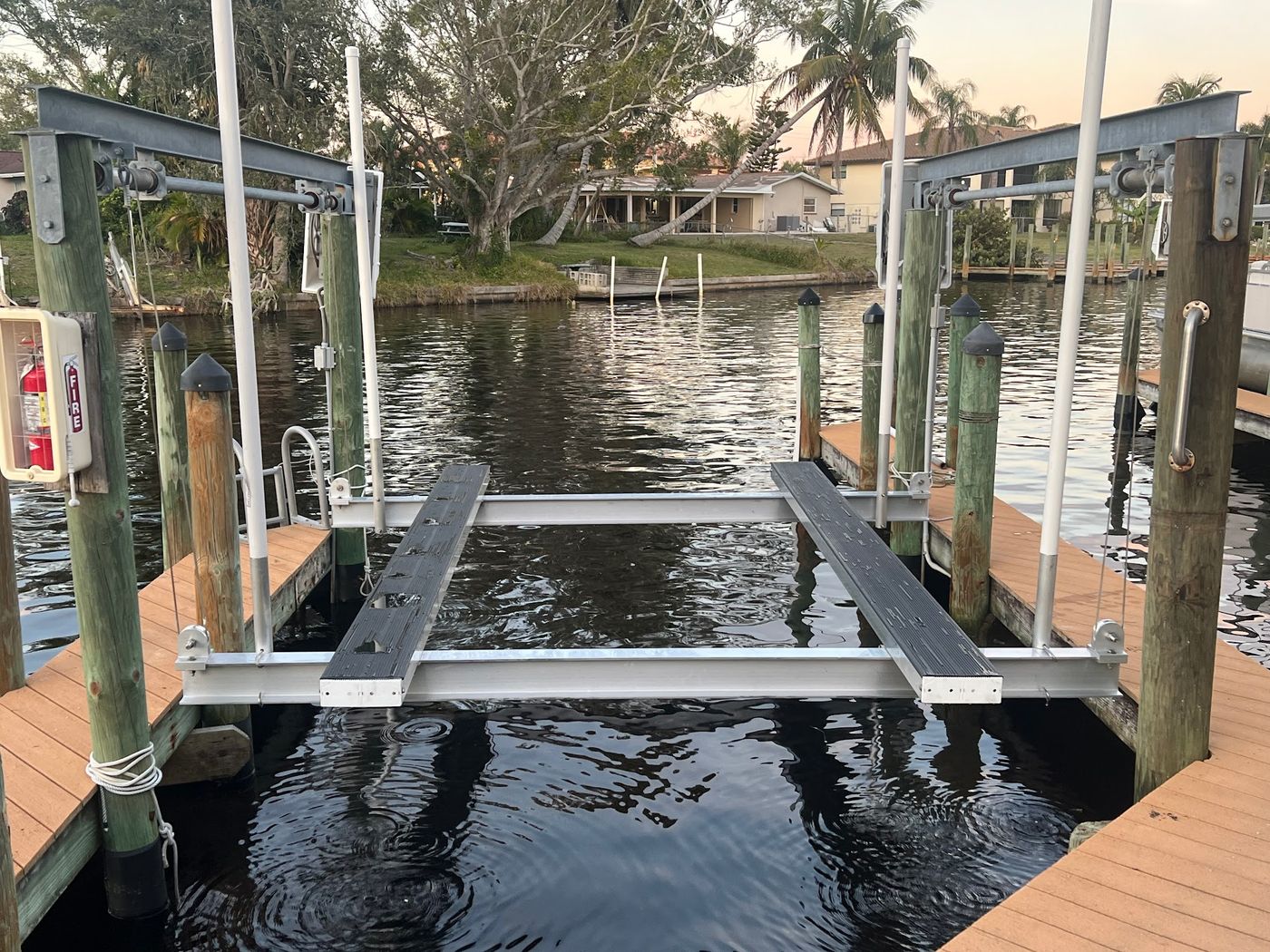
Guide · 03 · Lift Sizing
Size the lift to the boat you actually load
Almost every owner starts from a weight printed on a spec sheet. Your lift never picks up that boat. It picks up the one with full fuel, full water, all your gear and everything you have bolted on since.
A lift at its limit wears in silence
You are probably reading this with a number already in hand: something a dealer mentioned, something off a listing, something a neighbor guessed at over the fence. Almost always, it describes a boat that has never been fueled, never been loaded and never been fished from.
That gap looks small on paper and gets expensive in the water. A lift sized to a lighter boat still goes up and down. It behaves the first season. What changes is everything you cannot see from the dock: cables working harder on every cycle, a motor pulling longer, bunks and bushings carrying load nobody planned for. Nothing snaps dramatically. It just ages fast, and it ages while your boat hangs over salt water.
Getting it right is free at the sizing stage and costly afterward, so the boring arithmetic happens first, on your seawall, before anything is ordered. The owner does that part himself.
What actually goes into the number
A starting weight you can defend
Spec sheets, trailer scales and sale listings all quote different things, and none of them describe your boat on a Saturday. Pick the source you can explain out loud, then treat it as a floor to build up from, never as the answer.
Everything bolted on since
Towers, hardtops, extra batteries, trolling motors, electronics, a heavier anchor, the ladder somebody added. Upgrades never make a boat lighter, and they never appear on the weight the boat was sold with.
The loadout that lives aboard
Fuel and water you rarely run down, plus the gear that stays on the boat because hauling it off every weekend is nobody's idea of boating. Size the boat as it sits on a normal weekend, not as it sits at a boat show.
Margin, which is not padding
Rain sitting in the bilge, a hull that never centers perfectly, a cooler loaded heavy on one side, a season where the boat lives up in the cradle instead of coming down on weekends. Margin is what turns ordinary days into non-events.
The boat after this boat
Repower to heavier outboards, step up a hull, or finally buy the boat you keep circling, and the math moves with it. Sizing with the next boat in mind is the easiest upgrade you will ever make, because it happens on paper.
The water the lift has to live in
The beam of your hull, the width of your canal, how the boat comes in when the wind is pushing it sideways, and how much water you have at the low end of the tide. Weight decides capacity. Your canal decides most of the rest.
Get to a real number before you call
Write down the boat
Make, model and how it is powered. That is your starting point, and it is the one thing a published weight is genuinely useful for.
Add what came after
Walk the boat and list everything that was not on it the day it was new. Tower, top, electronics, batteries, ground tackle, the lot. This is the step owners skip, and it is rarely the small one.
Add the way you run it
Full fuel, full water, and the gear that never comes off. The test is simple: if you would take it out that way tomorrow, it counts today.
Put honest margin on the total
Not a gesture at rounding up. Real room, so the lift works comfortably on an ordinary cycle instead of living at the top of its range every time you come home.
Bring it to the seawall
Bring the boat details to the free inspection. The owner checks your number against your hull, your canal and what your seawall and pilings can carry, and tells you straight if what you brought is off.
Real work, real water
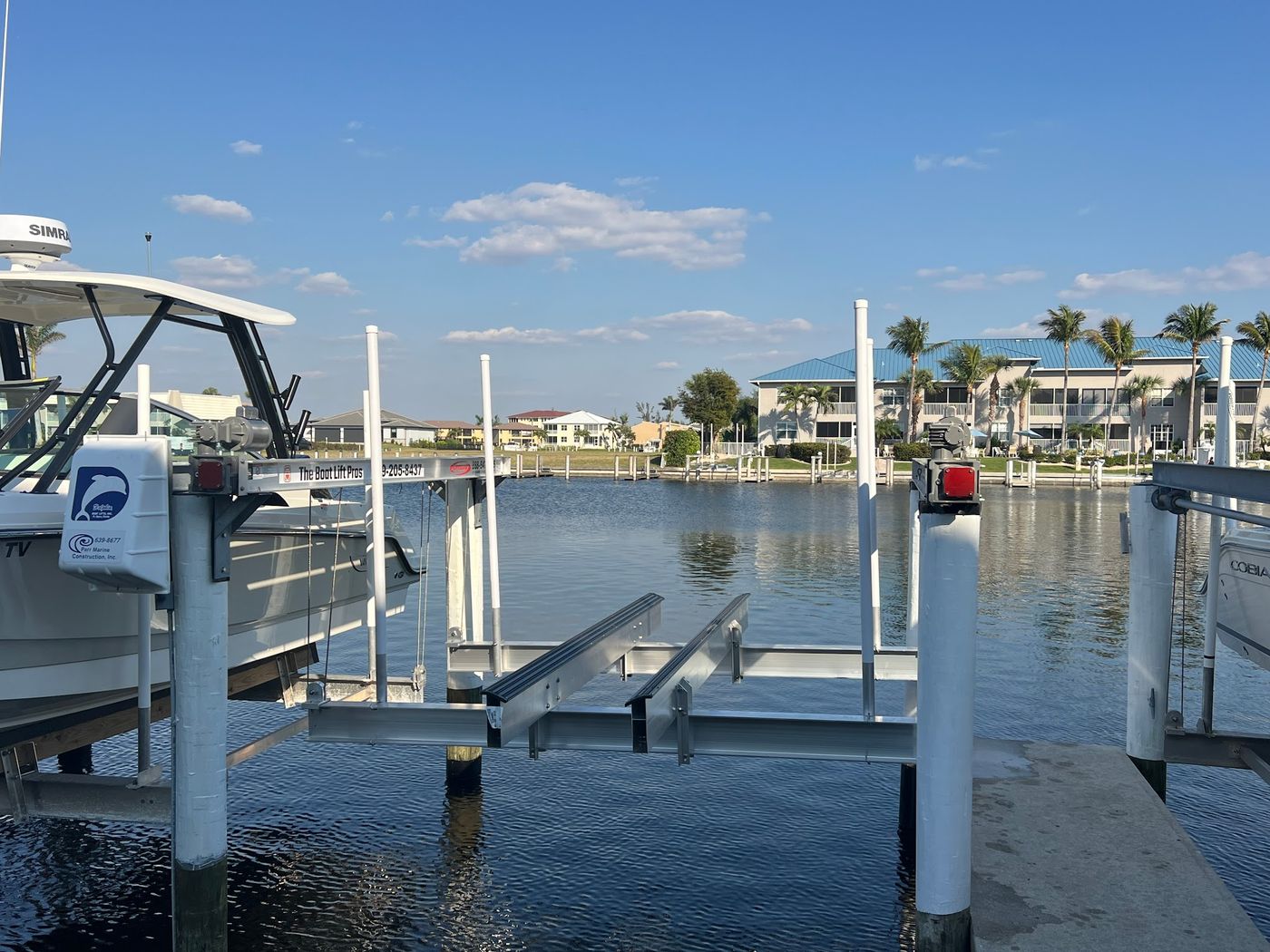
Every photo is our own work on SW Florida water. Click any of them to look closer.
Rated 5.0, 98 reviews
“Alex, and crew were able to get the job done quickly (when other contractors were months out). ... My dock is now finished and I could not be happier! I would highly recommend Alex for your dock building needs.”John Anderson · Google
Style follows the water, weight comes first
Owners usually open with the style question: four posts or something else, where the motors sit, how the cradle is built. Fair question, and the honest answer is that style is the second decision. A beautifully chosen lift sized under your wet weight is still a lift sized under your wet weight.
Once the weight is settled, your water picks the style. Canal width, the room between your seawall and your neighbor's, how the boat sits at the low end of the tide, whether the hull is a deep V, a pontoon or something flat and shallow. The owner walks all of that at the seawall and tells you which style fits your canal and which one only looks good in a brochure.
| Four-post cradle lifts | The familiar setup behind most canal homes: beams running between dedicated pilings, a cradle carrying the hull, cables and motors up top. It suits a straight seawall with honest room in front of it. |
|---|---|
| Seawall-mounted styles | Where a canal is tight or pilings out front are awkward, styles that carry the load closer to the wall enter the conversation. Whether they fit depends entirely on the seawall and the water right in front of it. |
| Shallow-water and small-craft lifts | Skiffs, flats boats and personal watercraft ask different questions: how little water sits under the hull at the low end of the tide, and how easy the thing is to drive on and off single-handed. |
| Whatever the style | It stands on pilings driven for the job and carries a boat that weighs what it weighs. Those two facts outrank every other line on the quote. |
How to Size a Boat Lift: Understanding Wet Weight questions
Where to go from here
Boat Lift Installation
Sizing feeds straight into the install: dedicated pilings driven from the barge, cradle and bunks fitted to your hull, controls tested before we hand it over.
See the service Related guideBoat Lift Maintenance: A Seasonal Checklist
A right-sized lift still needs a maintenance rhythm. Cables, bunks, motors and hardware want eyes on them on a schedule, not after a noise.
Read the guideBring us the boat, we will bring the math
Tell us what you run and where your canal is. The owner comes out to the seawall, free, sizes the lift against what your boat actually weighs loaded, and tells you what your water can take.
Open 7 AM to 7 PM, 7 days a week · Call or text